
The skin is the body’s largest organ in terms of both surface area and weight, serving as a protective barrier while helping regulate body temperature and fluid balance and providing the body with a sense of touch. Supporting these everyday functions requires blood flow throughout the skin.
This is where skin microcirculation comes in.
Skin microcirculation refers to blood flow through the skin’s network of small blood vessels. Researchers can measure this localized blood flow to better understand what is happening within the skin and how it responds to topical products.
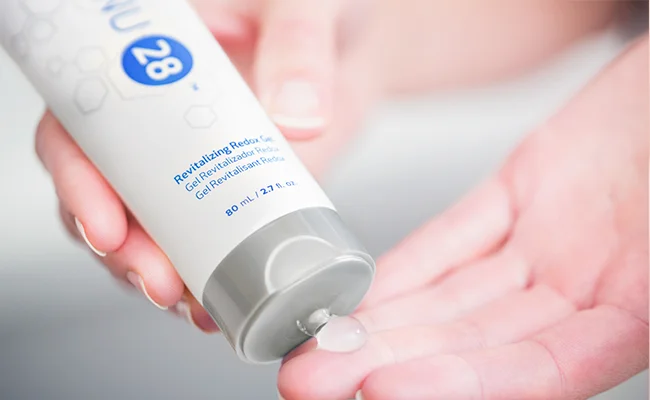
RENU28 Revitalizing Redox Gel is a topical skin care product powered by patented ASEA redox technology. ASEA positions RENU28 as an all-body skin care gel designed to support smoother, more toned-looking skin.
So, what is the connection between RENU28 and blood flow? In one study, researchers measured skin microcirculation after RENU28 was applied at the application site compared to the untreated control arm, both shortly after the initial application and after several days of continued use.
What Did the RENU28® Skin Microcirculation Study Examine?
To study the relationship between RENU28 and skin blood flow, participants applied RENU28 to one forearm twice each morning and twice each evening. The other forearm was left untreated, providing a control site that researchers could use for comparison.
Researchers measured microcirculation in the skin using Laser Doppler Flowmetry (LDF). This allowed them to compare measured blood flow at the RENU 28 application site with the untreated forearm at several points throughout the study.
Measurements were taken within 15 minutes of the initial RENU28 application and again at one hour and three hours. Participants then continued the same morning and evening application schedule, with additional measurements taken at 48 and 96 hours.
Importantly, the 48- and 96-hour measurements were performed before the RENU28 was applied that morning. This meant those measurements did not simply reflect the effects immediately following the latest application. Instead, researchers were able to evaluate differences in skin microcirculation after participants had been using the product according to the study protocol for multiple days.
By comparing treated and untreated sites on the same participants, researchers could observe microcirculation differences at the area where RENU28 gel was applied.
What Did the RENU28® Study Find About Skin Microcirculation?
The study reported increases in measured skin microcirculation on the RENU28-treated forearm compared with the control arm at each measured time point.
| MEASUREMENT | REPORTED BLOOD FLOW INCREASE |
| Within 15 minutes of first application | 49% |
| 1 hour after initial application | 34% |
| 3 hours after initial application | 35% |
| 48 hours into the study | 44% |
| 96 hours into the study | 55% |
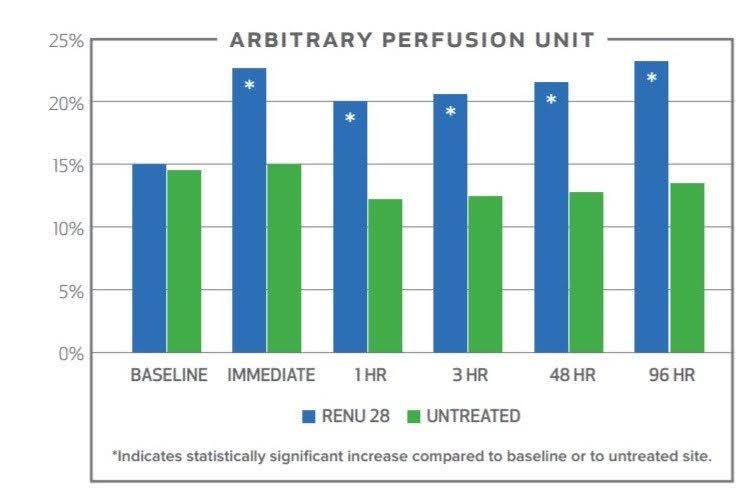
Within 15 minutes of the first application, researchers measured a 49% increase in blood flow at the RENU28 application site compared with the study’s control. At one hour, the measured increase was 34%, followed by 35% at three hours.
The difference remains measurable as participants continued using RENU28. At 48 hours, researchers reported a 44% increase in blood flow, while the largest reported difference occurred at the final 96-hour measurement, when the RENU28 application site showed a 55% increase in measured blood flow compared with the control.
The original study visual also identifies which measurements reached statistical significance. Those markers provide additional context for interpreting the differences between the RENU28 application site and the untreated site.
What Do These Findings Mean?
The findings suggest that applying RENU28 was associated with changes in skin microcirculation at the application site under the conditions of this particular study.
That distinction is important when considering questions such as, “Does RENU28 affect blood flow?” The research measured localized microcirculation within the skin — not circulation throughout the whole body. The findings should not be interpreted as evidence that RENU28 increases whole-body circulation or that every person who uses the product will experience the same results.
Instead, the study offers insight into how skin blood flow responded in the area where RENU28 was applied. Because healthy blood flow supports normal skin function, studying microcirculation can help researchers better understand what happens beneath the skin’s surface.
Support Healthy-Looking Skin With RENU28® Revitalizing Redox Gel
RENU28 Revitalizing Redox Gel brings ASEA’s patented redox technology directly to the skin. ASEA’s redox technology centers on redox signaling molecules and their role in cellular communication, with RENU28 formulated as a topical way to deliver this technology to the skin.
Designed for all-body use, RENU28 supports smoother, more toned-looking skin while helping address cosmetic skin concerns. ASEA currently highlights benefits ranging from hydration to reducing the appearance of fine lines and wrinkles, while its broader RENUAdvanced skin care line is formulated for all skin types.
Whether you’re looking to support hydrated, healthy-looking skin or add ASEA redox technology to your existing skin care routine, RENU28 provides an easy way to incorporate redox signaling molecules into topical skin care.
Explore RENU28 Revitalizing Redox Gel
You can also learn how RENU28 fits into a daily skin care routine and the benefits of ASEA redox technology.