


Energy, recovery, immunity, cardiovascular balance. All of these depend on how efficiently your cells respond to stress. That underlying capacity is often referred to as cellular resistance: the ability of cells to adapt, maintain balance, and recover efficiently when exposed to internal and external stressors.
The Aspen Lab Study, conducted by ASEA, offers a rare look at how cellular systems respond over time in healthy adults. This post explores what that research reveals and why cellular resistance may be foundational to long-term health.
What the Aspen Lab Study Reveals About Cellular Resistance
The Aspen Lab Study began as a safety evaluation. Thirty healthy adults (ages 21-55) participated in a 120-day study designed to evaluate safety markers and systemic resilience while taking ASEA’s Redox Signaling Supplement.
Participants had no pre-existing conditions and were monitored across a range of biomarkers, including inflammatory cytokines and glutathione levels, to assess both safety and adaptive response. The results were compelling:
- 89% reduction in IL-1β, a major marker associated with systemic inflammation and oxidative stress
- 11.5% reduction in IL-6, a cytokine commonly linked to cardiovascular stress and inflammatory signaling
- 14.4% cumulative increase in glutathione, the body’s master antioxidant
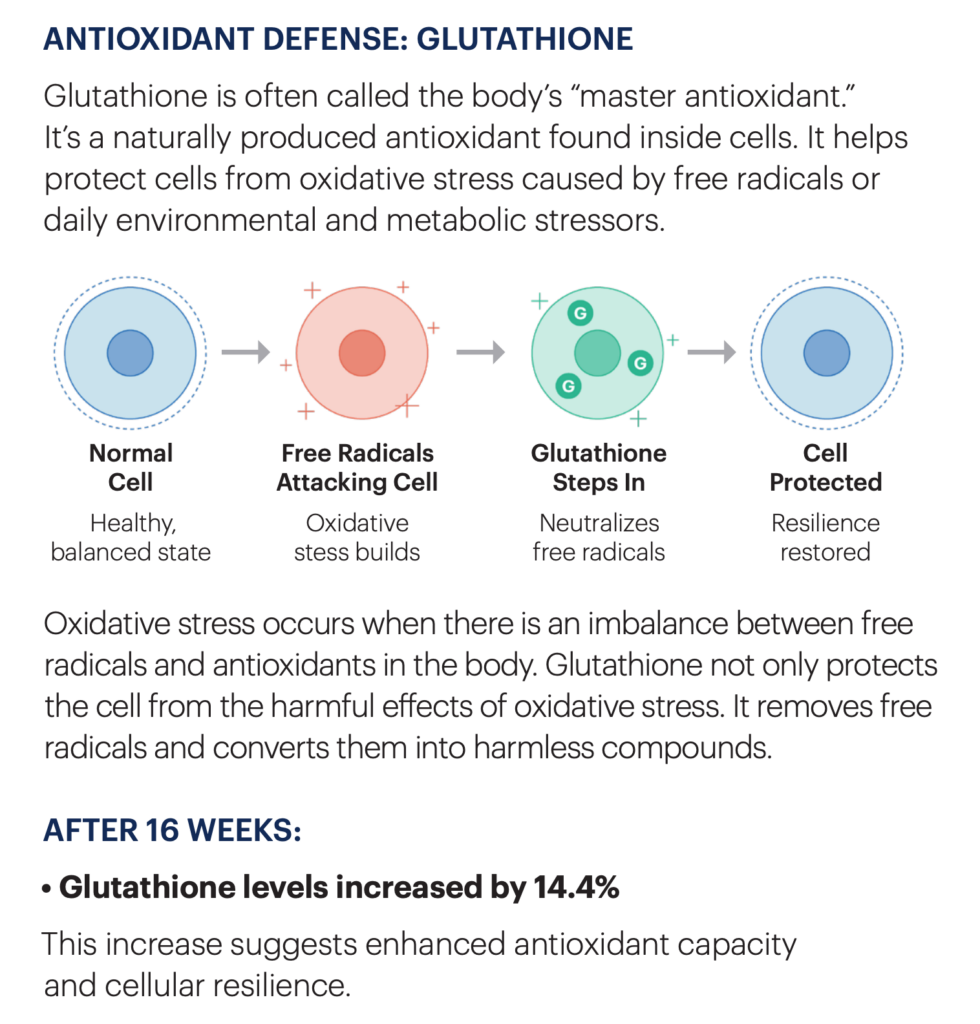
What’s especially important is the pattern of change. At 60 days, glutathione levels increased as inflammatory markers began decreasing. Over the following 60 days, IL-1β and IL-6 dropped even more dramatically, while glutathione production naturally downregulated. This suggests auto-modulation. When glutathione is produced endogenously (within the body), it adjusts according to need. This is different from externally supplemented glutathione, which must be used regardless of current need.
This is what cellular resilience looks like in action: the capacity of cells to respond appropriately to stress, restore equilibrium, and self-regulate over time.
Want to see the Aspen Labs Study for yourself? Check out this summary or the full findings here or watch the video below.
Supporting Cellular Resilience with Redox Science
ASEA has consistently invested in measurable science and long-term research to better understand how redox signaling impacts human health.
The ASEA Redox Cell Signaling Supplement is designed to support cellular communication using bioidentical redox signaling molecules, the same type of signaling molecules naturally produced within healthy cells. These molecules play a critical role in:
- Regulating oxidative stress
- Supporting endogenous glutathione production
- Enhancing cellular adaptation and recovery
- Maintaining systemic balance
Rather than targeting a single symptom, ASEA’s approach is foundational, supporting the body’s inherent ability to adapt, regulate, and maintain resilience over time. If long-term health, performance, and resilience matter to you, supporting cellular communication may be the most important investment you make.
Get ASEA’s Redox Signaling Supplement today!