

ASEA Redox Cell Signaling Supplement is a liquid supplement that contains redox signaling molecules. ASEA commissioned Pacific Northwest National Laboratory to evaluate ASEA Redox Supplement safety. They evaluated this by studying how cells respond when cultured cells come into direct contact with the ASEA Redox Supplement.
This in vitro study was conducted using cultured cells in a controlled laboratory environment. This particular study focused on eukaryotic cells. These cells contain highly organized structures that coordinate energy balance, metabolism, and gene expression. When stressed by a toxin, eukaryotic cells respond by sending transcription factors (proteins that control which genes are turned on or off) into the cell nucleus. These transcription factors then activate the genes responsible for cellular defense against toxins. If specific dyes are used to stain the cells, transcription factor movement is visible using a fluorescent microscope (called fluorescent microscopy) as they move into the nucleus.
During the study, researchers used fluorescent microscopy analysis to measure the toxicity response of eukaryotic cells when they came in direct contact with four different solutions.
How Was the ASEA Redox Supplement In Vitro Study Conducted?
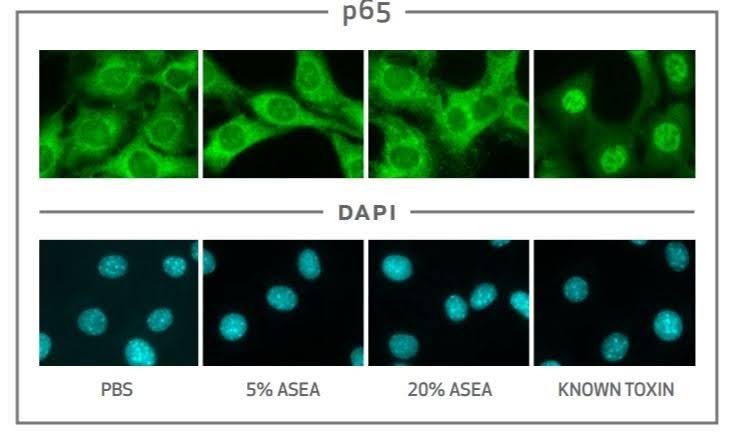
An in vitro study is conducted in a lab, outside the body. Researchers used the cultured target eukaryotic cells to study toxic responses. If a cell undergoes a toxic response, the fluorescent dye is pulled into the cell nucleus along with the transcription factor. In this study, researchers monitored two transcription factors: p65 subunit of NF-kappaB and P-Jun.
During this experiment, the eukaryotic cells were cultured and exposed to:
- Phosphate buffered saline (PBS)—the negative control where no toxic response was expected
- 5% ASEA Redox Supplement
- 20% ASEA Redox Supplement
- A known toxin—the positive control where a toxic response was expected
A DAPI stain was applied to the nuclei to help computer software identify cellular responses. After each exposure, the reaction of the transcription factors (tp65 subunit of NF-kappaB and P-Jun) was carefully captured using fluorescent microscopy.
In the photographs below, a toxic response is registered if the green dye moves into the nucleus.
What Did the ASEA Redox Supplement In Vitro Study Find?
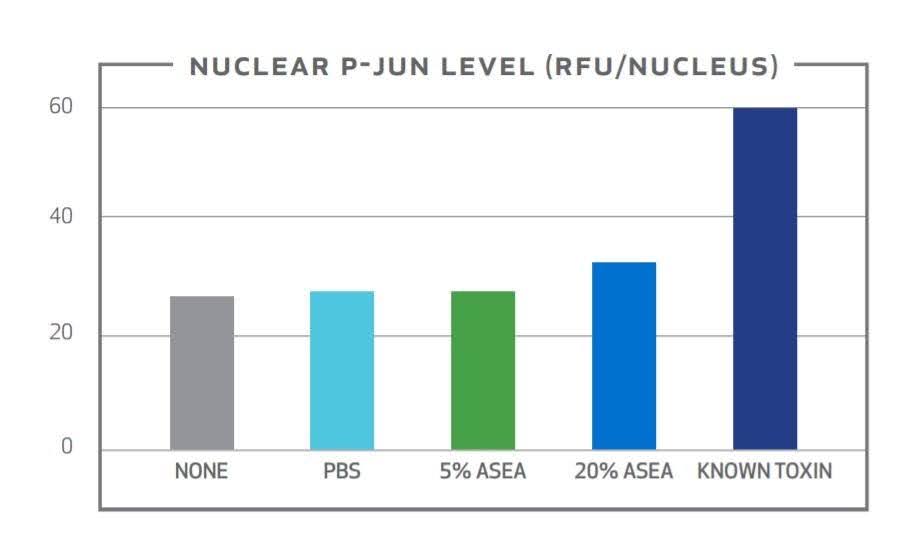
This study validated the hypothesis that direct exposure to the tested concentrations (5% and 20%) of ASEA Redox Supplement (as measured by nuclear translocation) did not register a significant toxic response.
The graph below shows the toxic response when eukaryotic cells came in contact with PBS, 5% ASEA solution, 20% ASEA solution, and a known toxin. While these are encouraging findings, we must also note that this study was conducted in vitro (in a lab) and not via a human consumption study; thus, the results of this study must be confined to the specific laboratory conditions and measurements used.
Learn More About ASEA Redox Cell Signaling Supplement
ASEA redox technology is at the heart of everything we do. In tandem with ongoing scientific redox research and its potential role in supporting cellular health, ASEA emphasizes quality-focused manufacturing and third-party testing and research.
Interested in learning more? We invite you to visit our ASEA Redox Cell Signaling product page for the most up-to-date information on ingredients, product details, and benefits.